Access to reports is limited to users with Admin permissions. If you don’t have the necessary permissions but need access to a report, please contact your account Admin.
Go to your profile menu (bottom left corner of the screen).
Click on the “Admin” bar.
Once in the Admin panel, go to “Reports”.
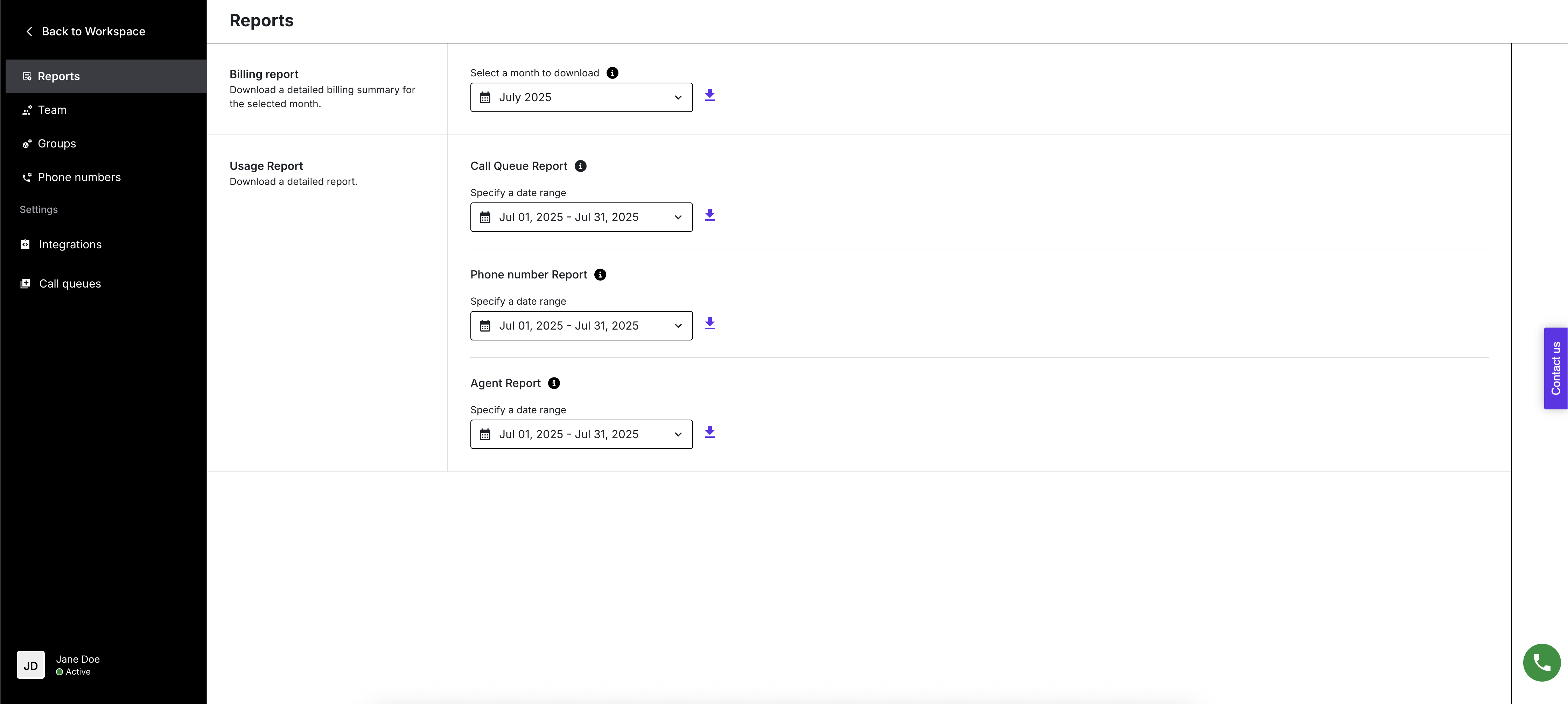
In the section of your interest, select the time period for which you’d like to generate the report.
Click on the “Download report” button.
The system will initiate the downloading process. The CSV file will be downloaded on your device shortly.
Each report includes a number of columns containing a specific range of data. To help you correctly interpret the report, we’ve included the complete data description below.
Date - The exact calendar date and time of when the call has started.
Type - The classification of the call. It can be inbound (incoming) or outbound (outgoing).
Client phone number - The phone number of an external party (e.g. your contact or client) that is not attached to your PhoneHQ account. This is a number that was called from your account, or one that called you.
Exposed phone number - Number active on your PhoneHQ account that has been used for the call, no matter whether the call was incoming or outgoing.
Call time (s) - The total duration of the call in seconds, measured from the moment the call is connected until it ends.
Cost ($) - The monetary cost of the call, in U.S. dollars, calculated based on PhoneHQ’s current call rates.
Name of the queue - The identifier or label of the specific call queue (e.g., “Support”, “Sales”), which is used to organize and route calls to specific groups or departments.
Number of incoming calls - number of calls received (answered and unanswered) by the queue, i.e. calls that were initiated by clients to a specific phone number. An incoming call to a specific number is counted as one, regardless of the number of users to whom the system offered that they answer the call.
Number of missed calls - the number of incoming calls that were not answered by any user. This means that callers did not get an answer – the call ended without speaking to a consultant.
Number of rejected calls - the number of calls that were intentionally rejected by at least one user, and ultimately did not reach the caller. Rejecting a call means that when the phone was ringing to the user, they intentionally did not accept the call (pressed the reject button).
Average incoming call time [s] - the average duration of answered calls in seconds — calculated by dividing the total call time by the number of answered calls.
Total incoming calls time [s] - the cumulative time (in seconds) spent on all incoming calls that were answered.
Average answer time [s] - This is the average time from the moment the system receives an incoming call to the moment it is answered by any user. This average is influenced by factors such as user response time (call answer time), length of voice messages, and time spent by customers making selections in the IVR).
Name of the phone number - The identifier or label of the specific phone number.
Phone number - a telephone number (PhoneHQ) that can be assigned to a person or people that customers call. When this number is called, the call is routed to assigned users according to established queue rules.
Number of outgoing calls - The number of telephone calls initiated by the Team outside, i.e. made by users from a group to customers or other (external) numbers. Outbound calls are those initiated by the company to the customer (as opposed to inbound calls initiated by the customer). This indicator shows how many calls the number users made outside during a given period.
Number of incoming calls - number of calls received (answered and unanswered), that were initiated by clients to a specific phone number. An incoming call to a specific number is counted as one, regardless of the number of users to whom the system offered that they answer the call.
Number of missed calls - the number of incoming calls that were not answered by any user. This means that callers did not get an answer – the call ended without speaking to a consultant.
Number of rejected calls - the number of calls that were intentionally rejected by at least one user, and ultimately did not reach the caller. Rejecting a call means that when the phone was ringing to the user, they intentionally did not accept the call (pressed the reject button).
Number of answered incoming calls - The value in this column represents the number of incoming calls that were successfully answered by the user.
Average incoming call time [s] - the average duration of answered calls in seconds — calculated by dividing the total call time by the number of answered calls.
Total incoming calls time [s] - the cumulative time (in seconds) spent on all incoming calls that were answered.
Average answer time [s] - This is the average time from the moment the system receives an incoming call to the moment it is answered by any user. This average is influenced by factors such as user response time (call answer time), length of voice messages, and time spent by customers making selections in the IVR).
Agent's name - set in the system during the onboarding, first and last name of the specific system user.
Number of outgoing calls - The number of telephone calls initiated by the user outside. Outbound calls are those initiated by the agent to the customer (as opposed to inbound calls initiated by the customer). This indicator shows how many calls the agent made outside during a given period.
Number of incoming calls - number of calls received (answered and unanswered) by the agent. An incoming call to an agent is counted as one, regardless of the number of times the system offered the incoming call to the agent.
Number of missed calls - the number of incoming calls that were offered by the system, but not answered by the agent. This means that callers did not get an answer from the specific agent.
Number of incoming calls during DND - The number of calls that came in to an agent while they had Do Not Disturb (DND) mode enabled. Do Not Disturb (DND) is a system feature that prevents calls to a specific user from being made – when an agent sets themselves to DND mode, calls will not ring to them. Instead, they may be automatically forwarded to other available agents. This metric shows how many calls tried to reach an agent while they were unavailable (DND), which usually means that those calls were handled differently (e.g. transferred to a colleague or not handled at that time). Because DND blocks calls to an agent from ringing, calls in this state were neither answered nor rejected by the agent, but simply bypassed their phone.
Number of rejected calls - the number of calls that were intentionally rejected by the agent. Rejecting a call means that when the phone was ringing to the user, they intentionally did not accept the call (pressed the reject button).
Average incoming call time [s] - the average duration of a telephone call handled by the agent, measured in seconds. In other words, it is the average time spent talking to a customer from the moment the call is answered to the end of the call
Total incoming calls time [s] - the total duration of all telephone calls handled by the agent, measured in seconds. In other words, it is the total time spent talking to customers within the selected timeframe.
Average answer time [s] - This is the average time from the moment the system receives an incoming call to the moment it is answered by an agent. This average is influenced by factors such as user response time (call answer time), length of voice messages, and time spent by customers making selections in the IVR).